

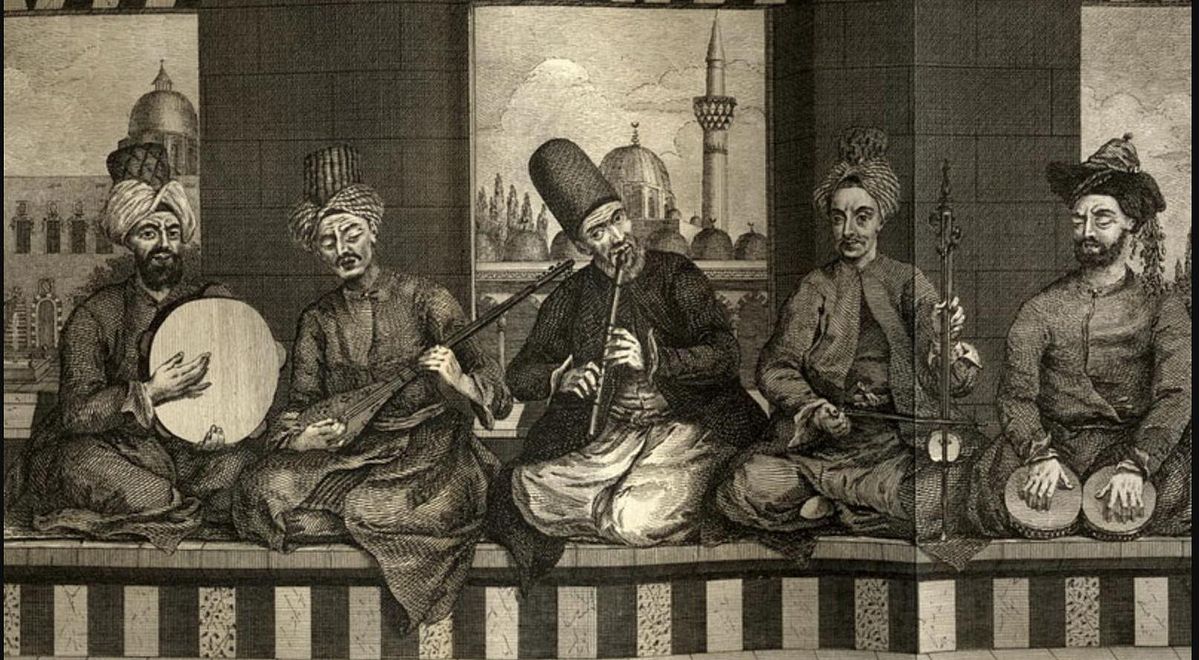
Early Modern Ottoman Music: An Introduction
Most critics agree on the impossibility of tracing Ottoman traditional urban music before 1603 for several reasons. The reliance of Ottoman music on the master-apprentice system, the practice of notating only the lyrics through güfte mecmuaları (song-text collections), and the absence of a precise notation system that could fully capture traditional Turkish music (later referred to as microtonal) are among the reasons behind this. Performing backward analyses through the musicological notations of Ali Ufki and Dimitrie Cantemir from the 17th to the 18th centuries may again be misleading, as most critics agree that prior to 1603, Ottoman music was influenced by Persian music before it gained its distinctive features. Persian influences in literature and the arts were by and by abandoned because of the geopolitical risks triggered by the Ottoman-Safavid War (1603-1618), which is why any trace of Persianate music before 1603 is currently non-existent in the archives.
Both the increasing multiculturality of the Ottoman court and innovations in musical instruments used in chamber music through the use of ensembles of ney (reed flute), tanbur (long-necked lute) and kanun (plucked zither) were behind this change. Forms such as the peşrev (instrumental prelude) and semai, along with cyclical fasıl concerts and Mevlevi ayin rituals, gained structure.
Central to Ottoman music is the makam (maqam) system, which is a modal framework defined by specific interval structures (called cinsler, often tetrachords and pentachords), characteristic melodic progressions (seyir), and emotional character. Unlike Western scales, makams are melodic types guiding both composition and improvisation.
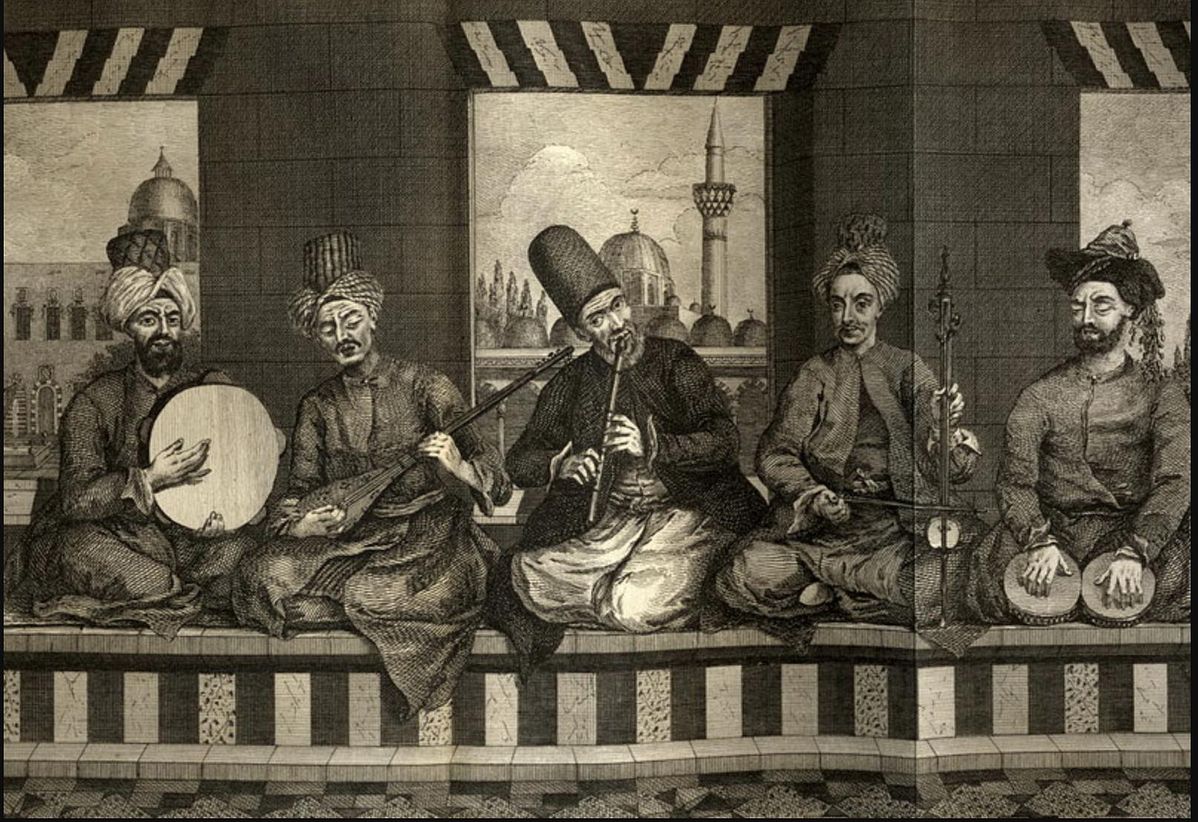
Alexander Russel (1794). (Public Domain). Image via Wikimedia Commons
In Ottoman musical theory, which seamlessly integrated music with Galenic humoral medicine, Islamic cosmology, and classical philosophy, specific makams were believed to restore bodily and spiritual harmony by influencing the four humours and human temperaments. Rast, often foundational and associated with joy, tranquillity, and stability through its characteristic pentachord and tetrachord, was prescribed for paralysis, fevers, and general balance. Hüseyni evoked pastoral serenity and emotional depth while addressing heart and lung issues, reducing inflammation or fever. Hicaz, dramatic with its augmented seconds, conveyed intensity or humility and was used for specific pains or to induce sleep. Uşşak offered gentle joy and emotional uplift, linked to laughter, while Saba’s melancholic yet courageous character featured a distinctive lowered second degree. Other makams, such as Rehavi for calming nerves and instilling tranquillity, Isfahan for mental clarity and memory, and Nevâ for refreshing the spirit and easing hip pain, further illustrated this therapeutic approach, with versatile modes like Segah and Buselik providing varied emotional shading.
While Ottoman traditional urban music is based on certain frames of the said makams, it allows for personal interpretations, most vividly observed in taksims, that is, improvisational instrumental pieces usually performed before a composed musical piece. Here is Aka Gündüz Kutbay’s collection of several taksims: https://youtu.be/ofdHozAQEwE?si=4-JmX-AIN0X5U6yY.
I hope that this brief introduction to early modern Ottoman music might be helpful to our readers in conducting further research.
Select Bibliography
Behar, Cem. “The Ottoman Musical Tradition.” The Cambridge History of Turkey. Ed. Suraiya N. Faroqhi. Cambridge: Cambridge University Press, 2006. 391–407.
Somakcı, P. “Türklerde Müzikle Tedavi.” Erciyes Üniversitesi Sosyal Bilimler Enstitüsü Dergisi 1.15 (2003): 131-140.

